


.svg)


.jpg)
AI is moving beyond generating answers.
The next phase is about taking action.
Following ChatGenie CEO and Co-founder Ragde Falcis’ recent appearance on ANC’s Startup, ABS-CBN News published a follow-up feature titled “Agentic AI is moving into business decisions.”
.png)
The article captures a shift we are already seeing in enterprise AI: from systems that simply respond to users, to systems that can increasingly execute workflows, interact with business systems, and make decisions within defined boundaries.
From answering to acting
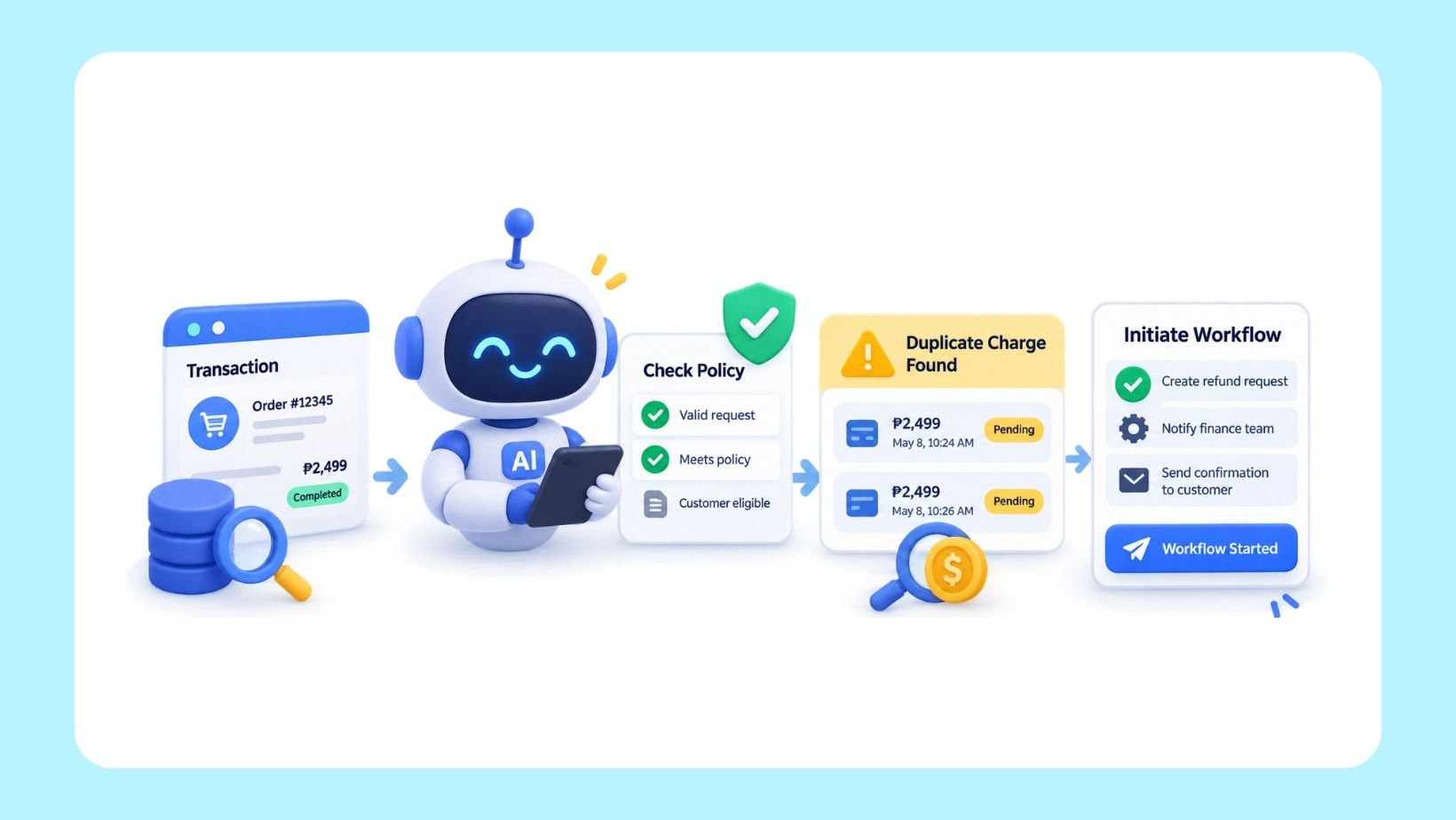
A traditional chatbot might explain how a refund works.
An AI agent could potentially retrieve the transaction, check whether the request meets policy, identify a duplicate charge, and initiate the appropriate workflow.
That makes AI much more useful—but also much more consequential.
The key question for companies becomes:
How much authority should AI be given?
At ChatGenie, we believe the answer should depend on risk.
Low-risk requests such as FAQs and order status can often be automated. Higher-risk cases involving fraud, serious complaints, refunds, or financially sensitive transactions should still involve human judgment.
Automate routine decisions. Keep humans for consequential ones.
Reliability matters more as AI gains autonomy
.jpg)
Once AI can take action, accuracy and guardrails become critical.
As Ragde shared during the interview:
"The objective is to be right, to be correct 99 percent of the time."
That is why enterprise AI requires more than a capable language model.
Agentic systems need guardrails, orchestration, validation, integrations, and evaluation mechanisms to ensure the AI behaves reliably before it is trusted with real-world consequences.
The goal is not simply to make AI sound intelligent.
The goal is to make it reliable enough to act.
AI still has to prove the economics
Enterprise AI should ultimately be measured by business outcomes.
Across selected ChatGenie customer-support deployments, we have seen OPEX reductions of around 30%, reaching as high as 77% in some cases, together with up to 10x faster ticket resolution.
These are results from specific ChatGenie deployments, not industry-wide benchmarks.
The broader point is simple:
AI accuracy is a technology metric. Business value is what matters to the enterprise.
Human judgment becomes more valuable
AI will also reshape work.
Some repetitive tasks will disappear, some roles will change, and new ones will emerge. As AI makes execution cheaper, skills such as domain expertise, first-principles thinking, communication, and judgment become more valuable.
This creates an important opportunity for the Philippines.
Instead of viewing AI only as a threat to BPO jobs, the country could move from exporting labor to exporting AI-enabled business operations—where Filipino professionals work alongside AI agents to deliver complete business outcomes.
That means competing on expertise, technology, and results, not just labor cost.
The future: tell software the outcome
Agentic AI may also change how we interact with software.
Today, people manually navigate applications, move information between systems, and coordinate workflows.
In the future, we may simply state the objective and allow AI agents to coordinate the work.
As Ragde said during the interview:
“Today we operate software. In the future, we’ll tell software the outcome we want, and AI agents will do the work.”
That is the direction we see for enterprise AI: not just better chatbots, but AI systems becoming an operational layer between people, software, and business processes.
For companies beginning that journey, the principle remains straightforward:
Start with a measurable business problem. Prove the return. Then scale.
Watch the full ANC Startup interview
Watch the Interview https://www.youtube.com/watch?v=mRKGJAUJLTc
Read the ABS-CBN News feature
Agentic AI is moving into business decisions
Read the Article https://www.abs-cbn.com/news/technology/2026/8/29/agentic-ai-is-moving-into-business-decisions-1400
.png)
.png)
.jpg)


